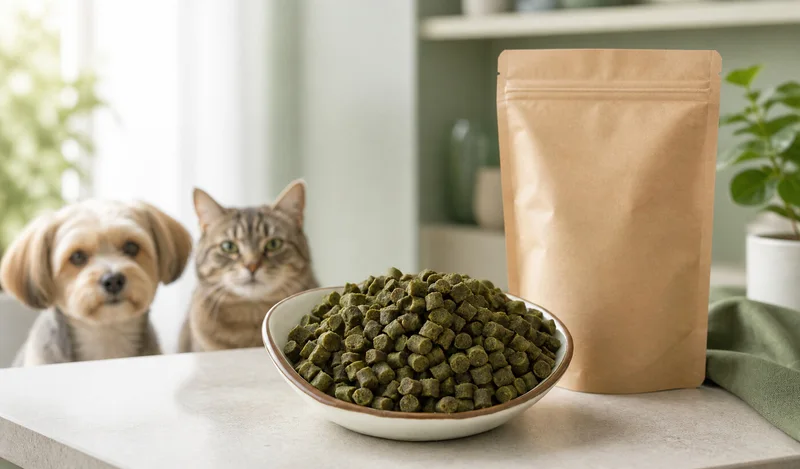
Seaweed Pet Snack Granules for Dogs & Cats, model XJ-DF-012, are a dry granule direction for importers, distributors, pet stores, e-commerce brands, and private label buyers who want to add a visually different snack format to a wider range. The reference supply format is a 10 kg bulk pack, with private label packaging available for qualified OEM/ODM orders. The small, irregular dark-green pieces look different from strips, biscuits, uniform kibble, and large meat chunks, which gives a buyer more ways to structure a snack assortment.
For any specialty-named pet treat, the most important commercial rule is simple: the product name, approved formula record, ingredient declaration, product images, and label claims must describe the same product. That is particularly relevant for a product sold under a seaweed-themed name. The reference ingredient record for this SKU lists frozen chicken, frozen salmon, chicken meal, corn starch, seafood powder, sodium chloride, and TBHQ. It does not list seaweed as a separate ingredient. A buyer should therefore confirm the final formula and approved claim route before using seaweed as a front-of-pack nutrition claim.
Use the product name as a formula-and-label checkpoint
There are two responsible routes when planning a seaweed-led retail story. If the final commercial formula includes a specified seaweed ingredient at an agreed level, the formula sheet, ingredient declaration, technical file, product name, and destination-market label all need to be updated and approved together. If the current reference formula is used without that change, the package should focus on the accurate product format and complete ingredient statement rather than implying an ingredient that is not declared.
This is not a minor artwork detail. It affects marketplace listings, distributor catalogs, customs and import documents, retailer questions, and buyer trust after the first shipment. A clear project brief prevents a good-looking package from making a claim that the final batch cannot support.
What the reference product actually provides
The current reference is a multi-protein snack direction for dogs and cats, built around chicken and salmon ingredients with chicken meal and seafood powder. It is not a single-protein, limited-ingredient, hypoallergenic, or veterinary product. The reference guaranteed analysis is crude protein at least 18%, crude fat at least 5%, crude ash no more than 10%, and moisture no more than 15%. Final specifications, local label declarations, and any feeding guidance should be confirmed during sample approval.
| Reference point | Buyer planning implication |
|---|---|
| Dogs & cats | Confirm the final species statement and serving guidance for the chosen market. |
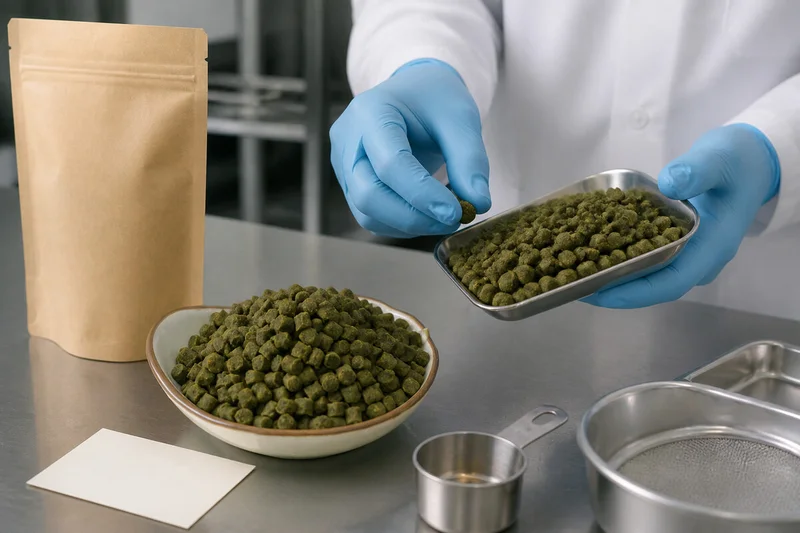
| Small irregular granules | Use real-product photography so the visual expectation matches the delivered product. |
| 10 kg bulk supply | Plan wholesale use, approved local repacking, or retail private-label packs from the same specification. |
| Chicken, salmon and seafood-powder direction | Declare the full animal-protein composition and avoid single-protein wording. |
Why this format can still add range variety
A snack range does not need every SKU to rely on an extreme health claim or a rare protein name. Sometimes the commercial advantage is a recognizable format that sits clearly beside existing treats. These irregular granules can be considered for mixed dog-and-cat snack collections, specialty retail displays, distributor sample kits, and e-commerce listings where product texture is visible in close photography.
For a buyer building a wider food and treats offer, format, protein direction, pack size, and price level should work together. The goal is not to create several packages that all say the same thing. Our pet food and snack range can be used to compare dry food, granules, chunks, and other formats before a private label shortlist is finalized.
Sample approval: inspect more than a photo
A product sample is the right time to align sensory appearance, formula records, packaging performance, and label language. The sample should be reviewed under normal room light and inside the proposed pouch or jar, not only in a studio photograph. Our quality and documentation approach helps connect an approved sample with batch checks and the export-order record.
- Appearance: dark-green color range, granule size mix, breakage, dust, and surface texture.
- Formula record: complete ingredient list, guaranteed analysis, and the exact product name to be used on packaging.
- Pack performance: net weight, seal integrity, moisture protection, coding area, storage statement, and carton strength.
- Claim review: confirm that every nutrition, protein, species, or ingredient statement can be supported by the approved formula and local rules.
- Commercial fit: target retail price, channel, first order quantity, reorder plan, and whether one or several pack sizes are needed.
Packaging and private-label planning
The reference 10 kg bulk format can support factory wholesale or an approved local repacking route. For a private-label retail project, the next discussion is usually not only bag size. It includes barrier material, closure type, shelf-facing design, destination-language panel, traceability code, storage requirements, carton count, and photography that reflects the real granule shape.
A smaller pouch can support trial and fast rotation, while a larger retail pack can suit repeat purchase or value-driven channels. The choice should follow the channel and expected turnover, not just the largest possible pack. During the OEM/ODM process, Xinji Pet Food can review formula direction, sample approval, private-label packaging, batch documentation, and export-order planning as one coordinated project.
Information needed for a useful quotation
Factory MOQ is discussed according to formula, package specification, number of SKUs, and total order scope. The reference lead time is 30–45 days after sample confirmation; packaging procurement, artwork approval, testing, and destination documentation can affect the final schedule. A useful inquiry should include the destination country, channel, desired pack size, estimated first or monthly quantity, target price level, label language, and whether the buyer wants to retain the reference formula or develop a revised formula route.
Start from the Seaweed Pet Snack Granules product page, then send your product brief. We can help qualified B2B buyers turn a product concept into a formula-supported, label-ready, export-planned snack program.