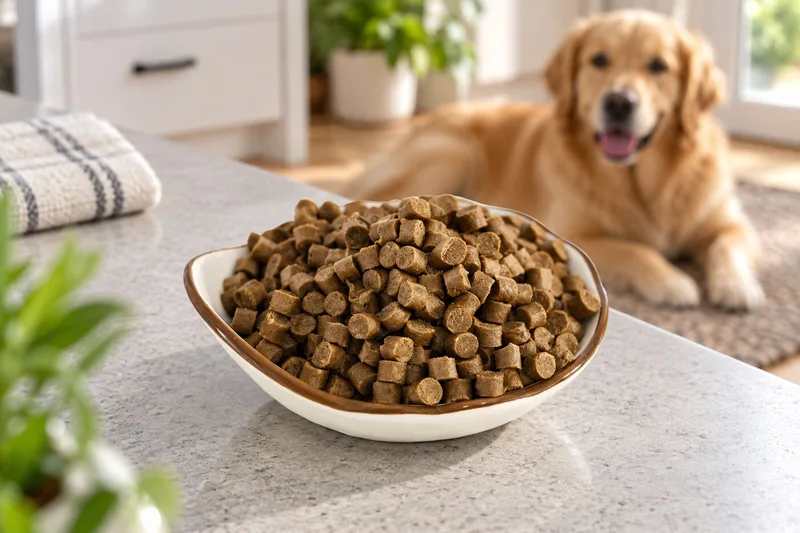
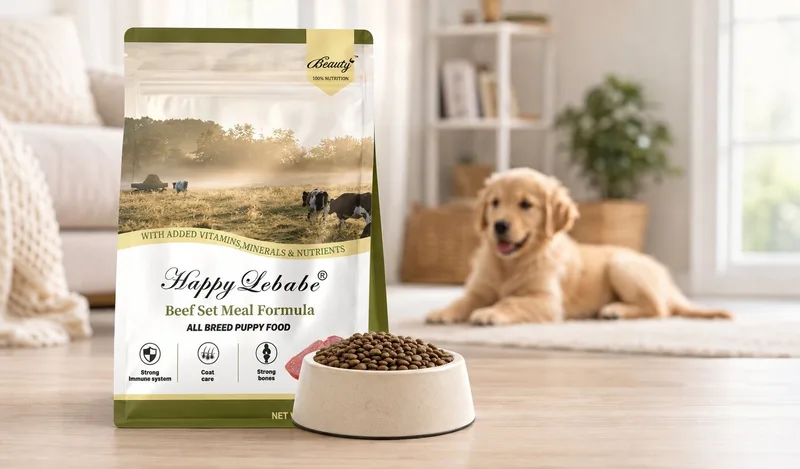
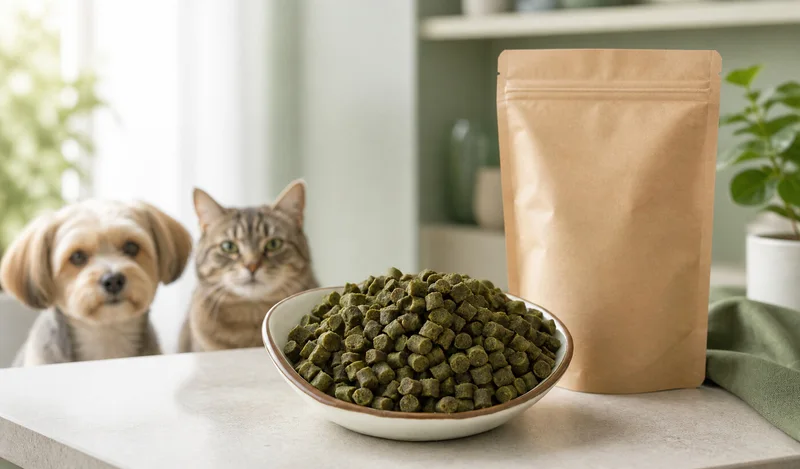
A pet snack range needs more than another flavor name. Buyers need to know what the product contains, how it differs from existing items, and what can be promised on the finished pack. Xinji Pet Food's Duck Granules, item 20010287, offer a distinct option for a dog and cat snack assortment: pale, short, roughly squared granules, a recipe containing duck and chicken, and a published reference analysis of at least 50% crude protein and 25% crude fat.
Available for wholesale and private label discussions in a listed 10kg bulk format, this product can be evaluated by pet shops, distributors, and brands developing a poultry-based treat range. The useful starting point is the actual specification, not an assumption that all duck snacks have the same ingredients or nutritional profile.
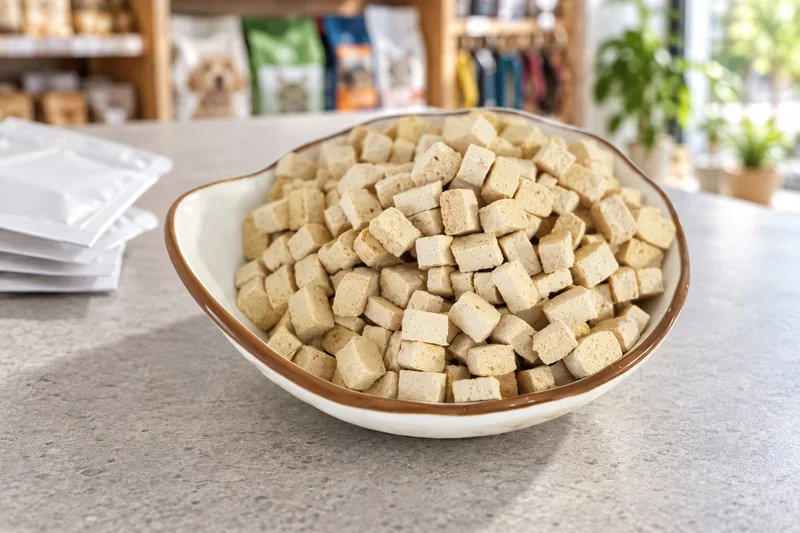
AI-generated setting based on the original product photograph. Packaging props are illustrative, not an approved retail pack.
A duck snack with a clearly stated recipe
The listed ingredients are frozen duck, frozen chicken, chicken meal, corn starch, chicken fat, and TBHQ. Duck is part of the recipe, but it is not the only animal ingredient. A brand can build a clear duck-focused product description while still declaring the chicken ingredients accurately.
This is not a basis for calling the reference formula single-protein, chicken-free, grain-free, or hypoallergenic. Nor does the name disclose the percentage of duck. If your positioning requires a specific inclusion level or a different ingredient policy, make that part of the development brief and have the factory confirm feasibility before preparing sales material.
Read the analysis before choosing the positioning
| Reference specification | Published value |
|---|---|
| Item number | 20010287 |
| Intended species | Dogs and cats |
| Catalog net weight | 10kg |
| Crude protein | Minimum 50% |
| Crude fat | Minimum 25% |
| Crude ash | Maximum 8% |
| Moisture | Maximum 6% |
| Calcium | Minimum 1.0% |
| Phosphorus | Minimum 0.8% |
These are the product page's published limits, not a report from the batch you will receive. They are useful for an initial comparison and should be confirmed in the order specification. A minimum fat value of 25% is particularly important when positioning the product: it does not support a low-fat or weight-control claim. The figures also do not establish calories per piece, protein digestibility, or suitability for animals with a medical condition.
Minimum calcium and phosphorus values cannot be used to calculate an exact calcium-to-phosphorus ratio. Likewise, a protein figure alone does not make this snack a complete diet. Request the final analysis, intended use, and feeding guidance for the formula and market being ordered.
A different role within a mixed snack assortment
The light-colored, roughly cuboid appearance gives this reference a different presentation from many dark, cylindrical snacks. That can help a buyer build an assortment with visibly distinct items, provided the final product photographs and descriptions match the approved sample. The image does not establish a freeze-drying process, softness, or crunchiness; confirm those characteristics directly.
A retailer considering a poultry and fish selection can also review our salmon granule snack guide. Compare the ingredient lists, species designation, analysis, and pack format as separate products. Avoid copying feeding directions or claims from one flavor to another just because both are described as granules.
The catalog identifies the duck reference for dogs and cats. That is not a promise that every piece size or feeding amount is appropriate for every animal. For a species-specific retail line, agree the intended age group, piece dimensions, serving guidance, and label wording before the packaging is finalized.
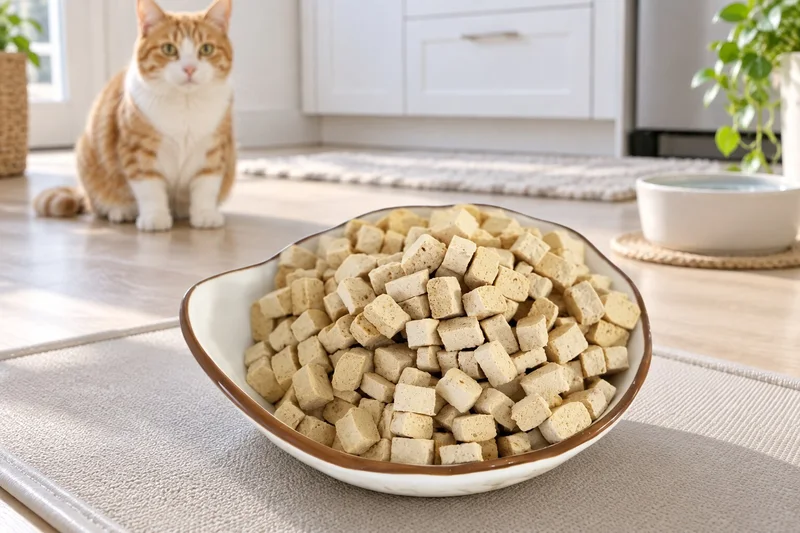
AI-generated home scene based on the product reference. The bowl is a product display, not a recommended serving. It does not represent a customer testimonial.
Build the sample review around texture and pack protection
Ask for a representative sample of item 20010287 and record its formula reference and batch identification. Check the actual piece dimensions, variation in color, surface texture, aroma, and the amount of loose material in the pack. Evaluate the product in its proposed finished packaging as well as in the sample container, so that the approval reflects how customers will receive it.
The listed moisture maximum of 6% is not, by itself, proof of shelf life or microbial stability. Ask how shelf life and storage instructions are established for the proposed formulation and packaging. For a resealable retail pouch, discuss the material, closure, seal integrity, and protection during distribution, along with any after-opening instructions. Do not assign a shelf life from a different product.
If you evaluate acceptance with dogs or cats, use the supplier's confirmed feeding guidance and document the conditions of your own assessment. Do not convert a single positive response into a universal palatability claim. A practical launch decision combines product specifications, sample observations, packaging checks, and feedback from the intended sales channel.
Wholesale supply or a private label project?
The 10kg catalog format is a supply reference, not confirmation that one pack is the minimum order. Buyers can discuss bulk procurement or a factory-packed private label program. The final MOQ, retail pack weights, printing requirements, carton arrangement, and delivery schedule depend on the agreed order.
Our OEM/ODM service process is the route for reviewing formula requirements, sample approval, packaging, and export coordination. Bring your destination country and sales channel into that conversation early. The reference formula includes TBHQ, so ingredient and additive declarations must be checked for the actual product and destination market rather than assumed from the English catalog.
What to send for a duck granule quotation
Share item 20010287, your target market, intended dog or cat range, estimated order quantity, and preferred pack weight. State whether you need bulk goods, finished private label packs, or a formula-development discussion. Add any ingredient exclusions, required label languages, and importer documentation requirements.
Contact Xinji Pet Food with your snack sourcing brief to request the current specification and sample arrangements. This makes it possible to review a product, packaging, and price together, and to build a duck snack offer around information that your purchasing team and customers can understand.